How to Go Viral on TikTok in 2026
To go viral on TikTok in 2026, you need two things: a video that holds attention in its first three seconds, and fast early engagement that convinces the algorithm to keep widening your audience. TikTok tests every upload on a small group of viewers first. If watch time, likes, comments, shares, and saves come in strong, it pushes the video to a bigger group, then a bigger one. Follower count barely matters at the start, which is why brand-new accounts go viral every day.
This guide explains how the TikTok algorithm actually decides what to promote, then walks through the tactics that matter most, ranked by impact, plus the most common reasons videos stall.
How the TikTok Algorithm Works in 2026

TikTok's algorithm builds a unique For You page for every user based on what they watch, rewatch, like, share, and skip. For creators, the important part is how it treats new videos: distribution happens in stages. Your video is shown to a small test audience, and its performance with that group decides whether it moves to the next, larger wave. A viral video is simply one that keeps passing those tests.
TikTok has publicly described three groups of ranking signals:
| Ranking signal | What it includes | Weight |
|---|---|---|
| User interactions | Watch time, rewatches, likes, comments, shares, saves, follows, and negative signals like "not interested" | Strongest |
| Video information | Captions, keywords, hashtags, sounds, effects, and on-screen text that tell TikTok what the video is about | Medium |
| Device and account settings | Language, country, and device type, used mainly for matching, not ranking | Weakest |
Watch time is the signal that outweighs everything else. If viewers watch your video to the end, or loop it, TikTok reads that as proof the content is worth promoting. If they scroll away in the first second or two, distribution stops, no matter how good the rest of the video is.
The algorithm also filters some content out of recommendations entirely: videos a user has already seen, duplicated or spammy uploads, and content that violates guidelines. Reposting someone else's clip or re-uploading the same video repeatedly works against you.
One more thing worth knowing: the For You page adapts fast. TikTok recalculates interest signals constantly, so a video can pick up steam days or even weeks after posting if a new audience segment starts responding to it. That is why deleting "flopped" videos is usually a mistake.
12 Ways to Go Viral on TikTok, Ranked by Impact
These tactics are ordered by how much they influence the algorithm's decision to keep promoting a video. Nail the top of the list first; the rest compounds from there.
1. Win the first three seconds

Nothing else matters if people scroll past. Open with movement, a bold claim, a question, or the most interesting frame of the whole video. Tease the payoff ("wait for the end") so viewers have a reason to stay. If your average watch time is low, this is almost always the fix.
2. Maximize watch time and loops
TikTok's strongest signal is people watching to the end, then watching again. Cut every slow moment, keep the pacing tight, and consider endings that loop naturally back into the opening. Shorter videos are easier to finish, so keep clips tight while you are still growing.
3. Get engagement in the first hour
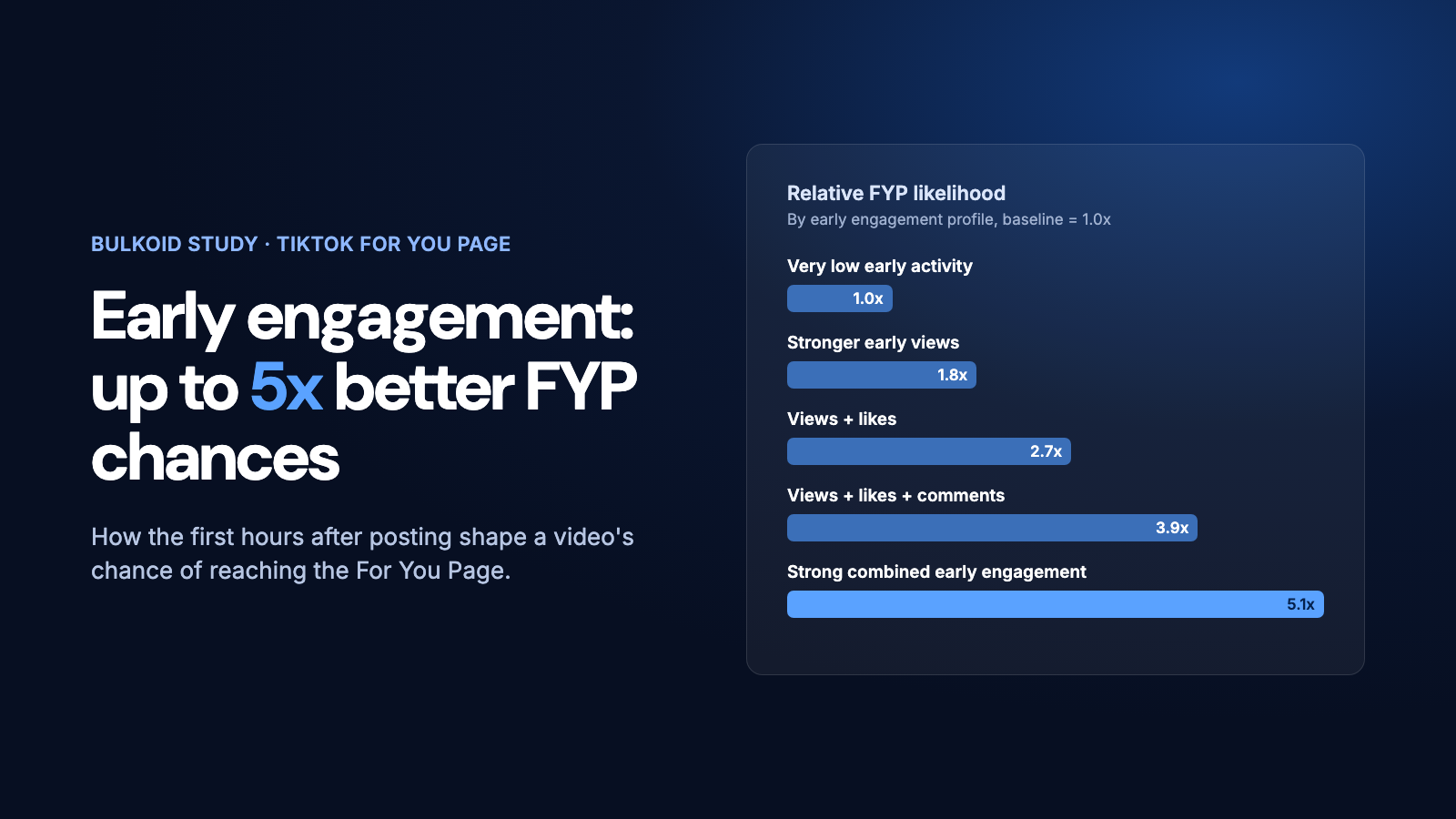
Early likes, comments, shares, and saves tell TikTok to expand the test audience. Ask a question in the caption, pin a comment that invites replies, and respond to comments quickly after posting. Comments that spark replies are worth more than passive likes.
4. Post when your audience is online
The early test wave works best when your followers are actually scrolling. Check your TikTok analytics for your own audience's active hours, and see our guide to the best times to post on TikTok for a starting schedule.
5. Jump on trends early, with your own twist
Trends carry built-in momentum, but the window is short. Use the trend as a structure, not a script: apply it to your niche, flip the format, or subvert the expected ending. A trend done identically to everyone else gets skipped; a trend with a twist gets shared.
6. Use trending sounds that fit your content
TikTok gives visibility boosts to videos using audio that is currently rising. Browse the Creative Center or your For You page daily, and save sounds you see repeatedly. Our guide on how to find trending TikTok sounds covers where to catch them before they peak.
7. Treat captions and hashtags as TikTok SEO

TikTok reads your caption, hashtags, on-screen text, and even spoken words to decide who should see the video. Include the words your target viewer would search for, and use 3 to 5 hashtags that mix one or two broad tags with niche-specific ones. Generic tags like #fyp on their own tell the algorithm nothing.
8. Post consistently

Regular posting gives the algorithm more data about your content and more chances for a breakout. Three to five posts a week is a realistic target. Consistency also means each video's audience feeds the next one: when one video performs, TikTok often gives your next upload a stronger test wave.
9. Stay recognizable within one niche
If your account jumps between unrelated topics, TikTok cannot figure out who to show your videos to. A consistent niche, tone, or format builds a repeat audience and sharper targeting. Experiment inside your lane, not outside it.
10. Make the video effortless to watch
Film vertically, in good light, with clear audio, and put text on screen for sound-off viewers. None of this is glamorous, but low production quality quietly kills watch time, and watch time is everything.
11. Tell a story with a payoff
Setup, tension, resolution. Storytime videos, transformations, and before-and-after formats go viral so often because the structure itself holds attention to the end. Even a 15-second clip performs better with a clear beginning, middle, and payoff.
12. Study your own analytics and double down
Your best-performing videos are telling you what your audience wants. Look for patterns in hooks, topics, lengths, and sounds, then make more of what works. Going viral repeatedly is usually iteration, not luck. If views are your bottleneck specifically, our guide on how to get more views on TikTok goes deeper on visibility tactics.
How Many Views Count as Viral?
There is no official number. Virality is relative to your account's normal reach and, more importantly, to how fast the views arrive: 20,000 views in a day on an account that usually gets 1,000 is viral behavior, while the same count spread over a month is not. We break down realistic view benchmarks by account size, and why momentum matters more than totals, in what is considered viral on TikTok.
Why You're Not Going Viral (and How to Fix It)

If you are applying the tactics above and still stalling, the cause is almost always one of these:
- Weak hooks. Viewers leave before the good part. Move your best moment to the front.
- Slow pacing. Long intros and filler sink completion rates. Trim aggressively.
- Unclear topic. If a viewer cannot tell what the video is about in two seconds, they scroll. Use on-screen text to frame it instantly.
- Scattered content. Posting across unrelated topics confuses the algorithm's targeting. Pick a lane for at least 30 days.
- Giving up too early. Most creators need dozens of videos before one breaks out, and old videos can resurface weeks later. Keep posting and keep iterating.
FAQ
Can you go viral on TikTok with zero followers?
Yes. TikTok evaluates each video on its own performance, not on your follower count. New accounts go viral regularly because the algorithm tests every video with a fresh audience sample and keeps promoting whatever holds attention.
How often should you post on TikTok to go viral?
Three to five posts a week is a realistic baseline. More posts mean more lottery tickets, but only if quality holds. One strong video a day beats three rushed ones.
Do hashtags help you go viral on TikTok?
They help TikTok categorize your video and match it to interested viewers, so use 3 to 5 relevant ones. They will not rescue a video with weak watch time, though. Hashtags are targeting, not fuel.
How long does it take for a TikTok to go viral?
Most viral videos show strong signals within the first few hours, but TikTok retests content continuously, so videos can take off days or weeks after posting. Do not delete slow starters.